
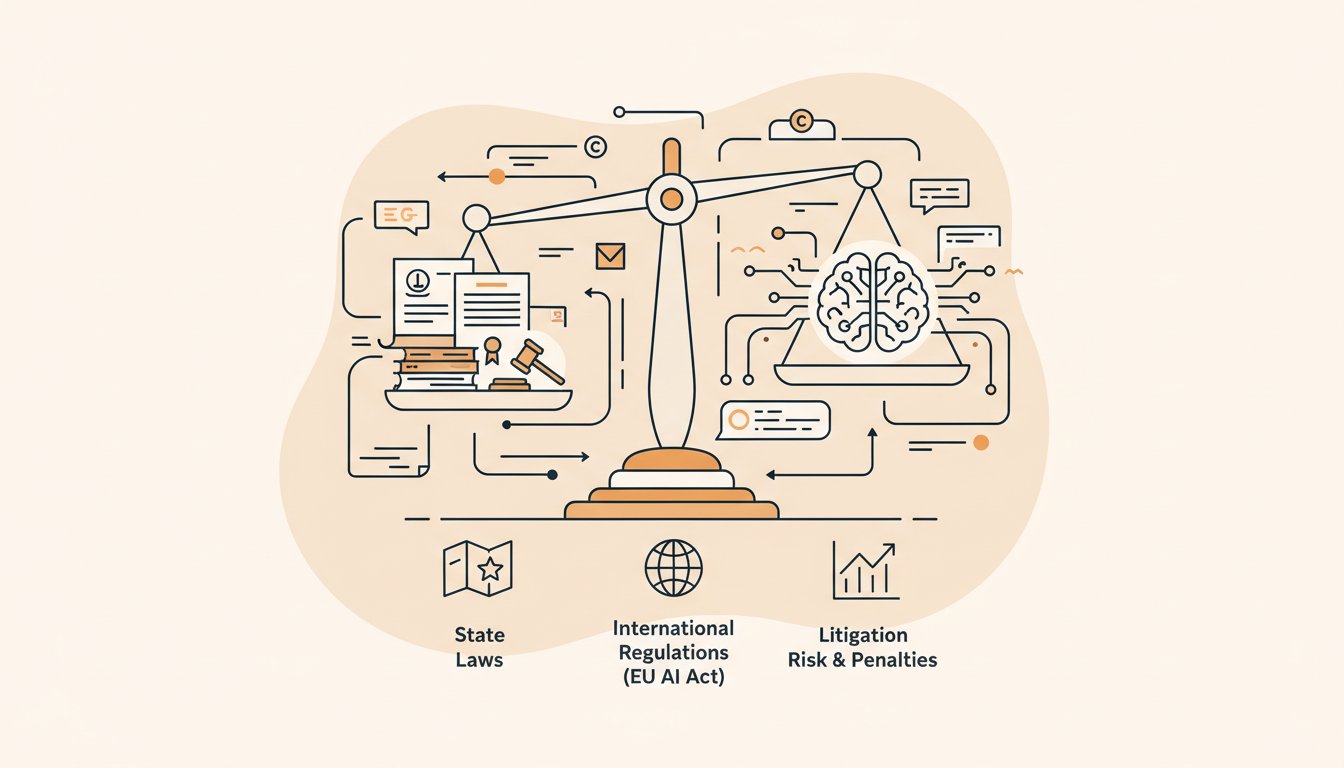
As of early 2026, the legal landscape surrounding artificial intelligence has shifted from theoretical risk to immediate enforcement. A report published on January 27, 2026, titled "The $1.5 Billion Reckoning," highlights a critical turning point for law firms and corporate legal departments. The convergence of state-level mandates, international transparency requirements, and high-value copyright litigation has made the provenance of training data a central pillar of corporate defensibility.
The Rising Tide of State and Federal Regulation
The regulatory environment in the United States is currently characterized by a complex interplay between state initiatives and federal oversight. For example, the Colorado Consumer Protections for Artificial Intelligence (SB24-205) is now a primary framework influencing how businesses must manage high-risk AI systems. Concurrently, federal developments such as the NO FAKES Act aim to address digital replicas and likeness rights, adding another layer of compliance for legal personnel to navigate.
Recent executive actions have signaled potential friction between federal and state authorities regarding preemption. However, practitioner summaries suggest that businesses cannot wait for a uniform federal standard. Effective January 2026, several state laws have already created concrete obligations regarding model transparency and risk assessment. Organizations utilizing legal AI software must now ensure their tools comply with these varying jurisdictional requirements to avoid statutory penalties and litigation exposure.
Implications for eDiscovery and Litigation Support
The shift toward stricter data governance has significant consequences for discovery processes. Litigation now frequently involves demands for model-training logs, data lineage, and proof of data rights. Legal teams are increasingly required to identify specific datasets used in model development, making technical recordkeeping as vital as traditional document preservation.
To meet these demands, firms are integrating AI litigation support to manage the technical complexities of provenance audits. In discovery, parties may be forced to defend model-training choices, necessitating a close partnership between attorneys and technologists. This evolution ensures that training-data claims do not lead to insurmountable discovery costs or adverse evidentiary rulings.
Contractual Risk Allocation and Insurance
The financial stakes of AI-related IP claims are rising, with illustrative settlement figures reaching into the hundreds of millions. In response, corporate counsel are prioritizing the following updates to their legal operations:
- Reviewing vendor and developer agreements to include robust indemnity clauses related to training-data sourcing.
- Implementing mandatory impact assessments and incident reporting pathways to satisfy statutory safety obligations.
- Evaluating technology errors and omissions (E&O) insurance policies to ensure coverage for model-risk and privacy exposures.
- Utilizing AI document review for litigators to identify potential copyright infringements within large internal datasets before they become liabilities.
Furthermore, the EU AI Act’s transparency requirements are impacting U.S. companies with international footprints, necessitating a cross-jurisdictional mapping of disclosure duties.
Strategic Readiness in the Courtroom
Developing a comprehensive litigation strategy AI tool requires more than just technical implementation; it requires a focus on privilege and work-product protection. As firms produce more technical documentation to prove compliance, the risk of privilege waiver increases. Counsel must manage communications regarding model design and data mitigation strategies with extreme care to maintain legal protections.
Admissibility is another concern. Attorneys must be prepared to present expert testimony regarding how models were trained and what steps were taken to mitigate bias and intellectual property risks. This technical defensibility is no longer optional but a prerequisite for navigating the 2026 regulatory minefield.
Conclusion
The current legal climate demands a proactive approach to AI governance. With state laws like Colorado’s in effect and federal legislative efforts ongoing, the window for voluntary compliance has closed. Law firms and corporate legal teams must treat data lineage, model provenance, and rigorous recordkeeping as immediate priorities to mitigate the high-dollar risks associated with AI copyright and regulatory enforcement.
Sources
- The $1.5 Billion Reckoning: AI Copyright and the 2026 Regulatory Minefield – ComplexDiscovery
- AI Legal Watch: January 2026 – Baker Botts
- SB24-205: Consumer Protections for Artificial Intelligence – Colorado General Assembly
- S.1367: NO FAKES Act – Congress.gov
- New State AI Laws and Executive Order Disruption – King & Spalding