
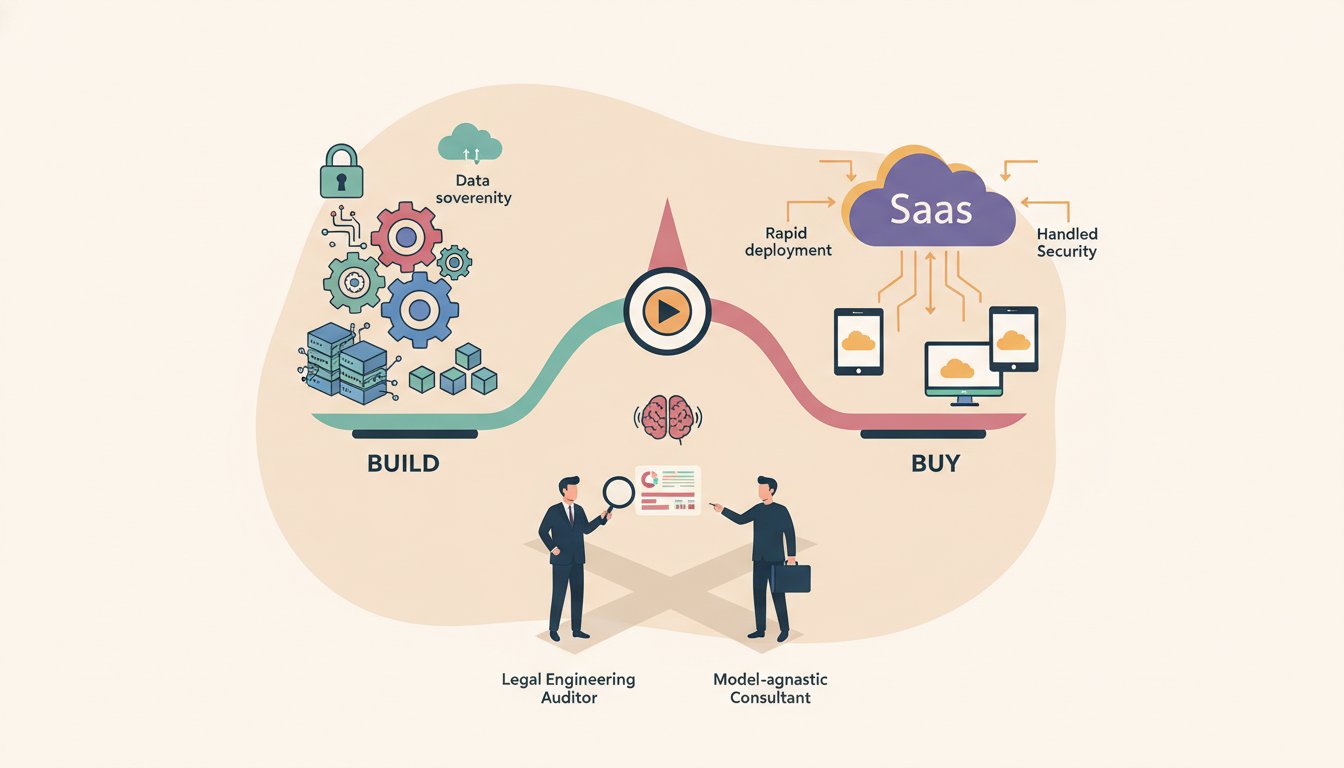
Legal departments and law firms are increasingly facing a critical strategic crossroad regarding their technological infrastructure. The decision to build vs buy legal AI involves a complex assessment of long-term scalability, data security, and immediate operational utility. As generative AI technology matures in early 2026, the industry has moved beyond general-purpose tools toward specialized applications that handle sensitive privileged information.
When assessing the feasibility of internal projects, many organizations seek comprehensive legal engineering services to audit their current workflows. This audit helps determine whether a firm has the internal data maturity to support proprietary systems or if they should rely on established vendors. The primary considerations typically include:
- Data sovereignty and the ability to keep client information within a private cloud environment.
- The total cost of ownership, including the ongoing maintenance of custom legal AI development.
- Integration capabilities with existing practice management and document management systems.
- The speed of deployment compared to the competitive advantage of a unique feature set.
The Strategic Role of Specialized Consulting
For firms that require flexibility across different large language models, engaging a model agnostic legal AI consultant has become a standard practice. This approach prevents vendor lock-in and allows firms to pivot between different underlying technologies as the market evolves. By maintaining a neutral stance on providers, firms can ensure they are utilizing the most efficient model for specific tasks, whether that involves document review, contract drafting, or legal research.
The decision-making process often requires a deep dive into what legal engineering consultants actually build for their clients. These experts often bridge the gap between raw technology and legal application, ensuring that the final product adheres to the ethical obligations of the legal profession. Professional build vs buy legal AI consulting provides a roadmap for this transition, highlighting the risks of technical debt versus the potential for high-margin proprietary tools.
Comparing Implementation Methodologies
One of the most significant technical hurdles in this debate is choosing between bespoke vs SaaS solutions. Software-as-a-Service (SaaS) offers the benefit of rapid deployment and handled security, but it may lack the granular control required for highly specialized practice areas. Conversely, bespoke builds allow for specific technical optimizations, such as the implementation of RAG versus fine-tuning methodologies to improve the accuracy of outputs based on the firm's specific historical work product.
Firms must evaluate if they have the internal bandwidth to manage custom legal AI development over several years. While initial development is the most visible cost, the iterative updates required to keep models current with the latest legal precedents can be substantial. For many, the hybrid approach—buying a robust core platform and building custom extensions—offers the most balanced ROI.
Conclusion
The choice between building and buying AI solutions is not binary but rather a spectrum of integration. Law firms must balance the desire for proprietary innovation with the practical realities of software maintenance and security. By carefully analyzing their internal capabilities and leveraging expert consulting, legal organizations can build a resilient AI strategy that serves both their attorneys and their clients effectively.
Sources
- Model Rules of Professional Conduct, American Bar Association
- Legal Technology Industry Analysis, Law.com / Legaltech News