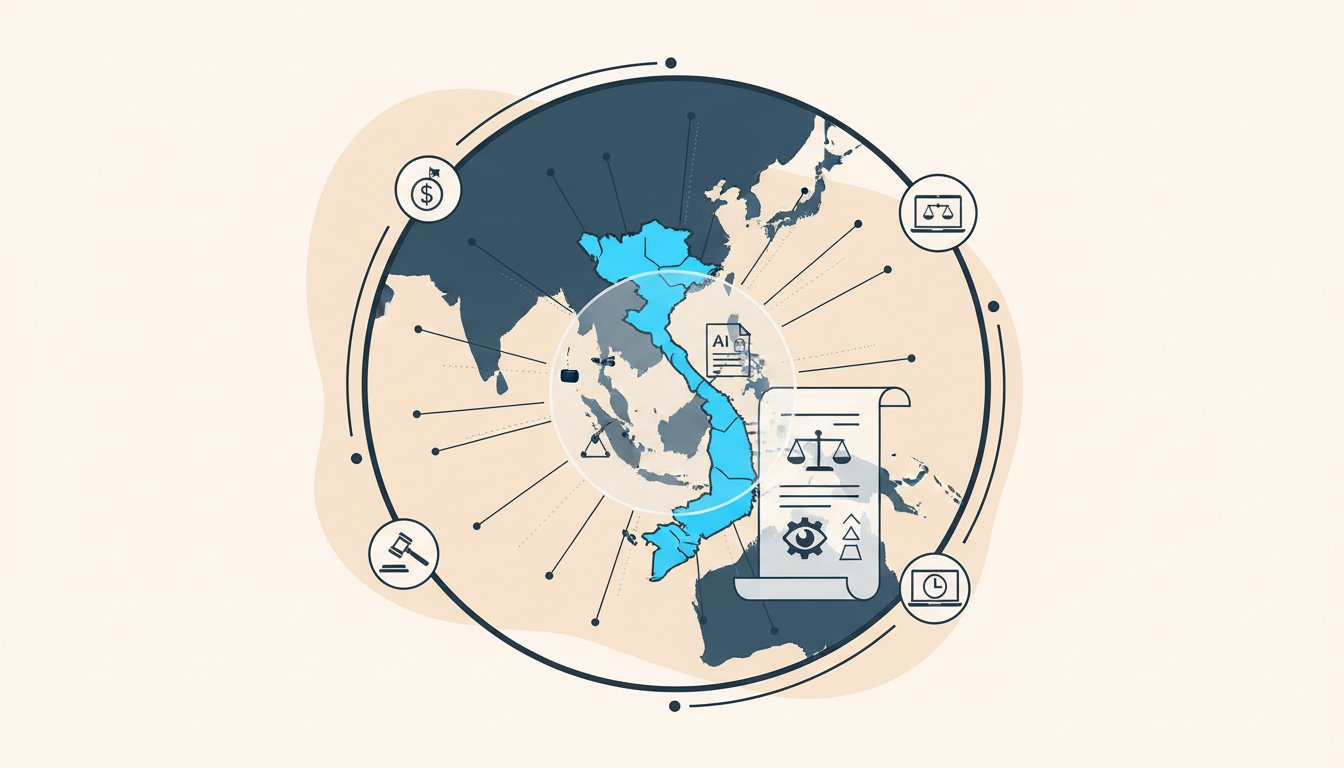
Vietnam’s Law on Artificial Intelligence officially entered into force on March 1, 2026, establishing a pioneering regulatory framework in Southeast Asia. While centered in Vietnam, the statute carries significant extraterritorial weight, impacting any international provider or developer whose artificial intelligence tools interact with Vietnamese users or data. U.S.-based legal departments must now evaluate how their current legal document generation system and broader technical infrastructure align with these new cross-border transparency and risk management standards.
A Risk-Based Framework for AI Governance
The new law categorizes AI systems into low, medium, and high-risk tiers, assigning specific duties to developers, suppliers, and implementers. Under this risk-based regulatory framework, high-risk systems are subject to mandatory conformity assessments before they can be deployed in the market. Key requirements under the statute include:
- Human Oversight: Systems must maintain human-in-the-loop processes to ensure accountability.
- Transparency Measures: Users must be notified when they are interacting with generative AI.
- Content Labeling: AI-generated content and deepfakes must be clearly labeled to prevent misinformation.
- Centralized Coordination: The Ministry of Science and Technology will oversee implementation and provide technical standards.
For foreign entities, the extraterritorial scope means that any AI system "affecting" Vietnam triggers these obligations, regardless of where the provider is headquartered.
Key Implications for U.S. Legal Counsel
Companies operating globally must integrate these requirements into their compliance workstreams. For instance, firms can leverage specialized legal prompt engineering services to ensure that AI outputs meet the transparency and labeling standards mandated by the new law. Counsel should also review training data provenance to mitigate intellectual property and licensing risks associated with generative models.
Furthermore, the need to automate contract review process workflows has become more urgent. Vendor agreements, warranties, and service-level agreements must now account for Vietnam's specific conformity assessments and developer duties. Organizations should consider how their internal legal engineering services can facilitate these necessary updates to cross-border contracts.
From a dispute resolution perspective, the use of AI for litigation support will likely involve new forms of evidence. Under the Vietnamese law, model logs, training data provenance, and human-oversight records are expected to be discoverable and may serve as central evidence in future enforcement actions or lawsuits.
"The law’s extraterritorial reach means in-house counsel and outside counsel must assess whether client products or services 'affect' Vietnam and therefore trigger new obligations."
Conclusion
Vietnam’s AI law sets a new benchmark for regulation in Southeast Asia, emphasizing transparency, risk mitigation, and human oversight. For U.S. firms and insurance companies, the immediate priority is assessing the extraterritorial impact on their digital products and updating internal governance structures. As the Vietnamese government issues further implementing decrees and technical standards, legal teams must remain vigilant to ensure continued compliance in an increasingly regulated global AI landscape.
Sources
- Vietnam AI law takes effect, first in Southeast Asia - GMA News / Agence France-Presse
- Law on Artificial Intelligence (Vietnam, 2025) Summary - Regulations.AI
- A boost for Vietnam's AI to break through - Vietnam Government Portal
- Vietnam’s First AI Law Delivers Risk-Based Rules - CompleteAITraining
- What’s on the Horizon for Data, Technology, Privacy and Cybersecurity? - Baker McKenzie