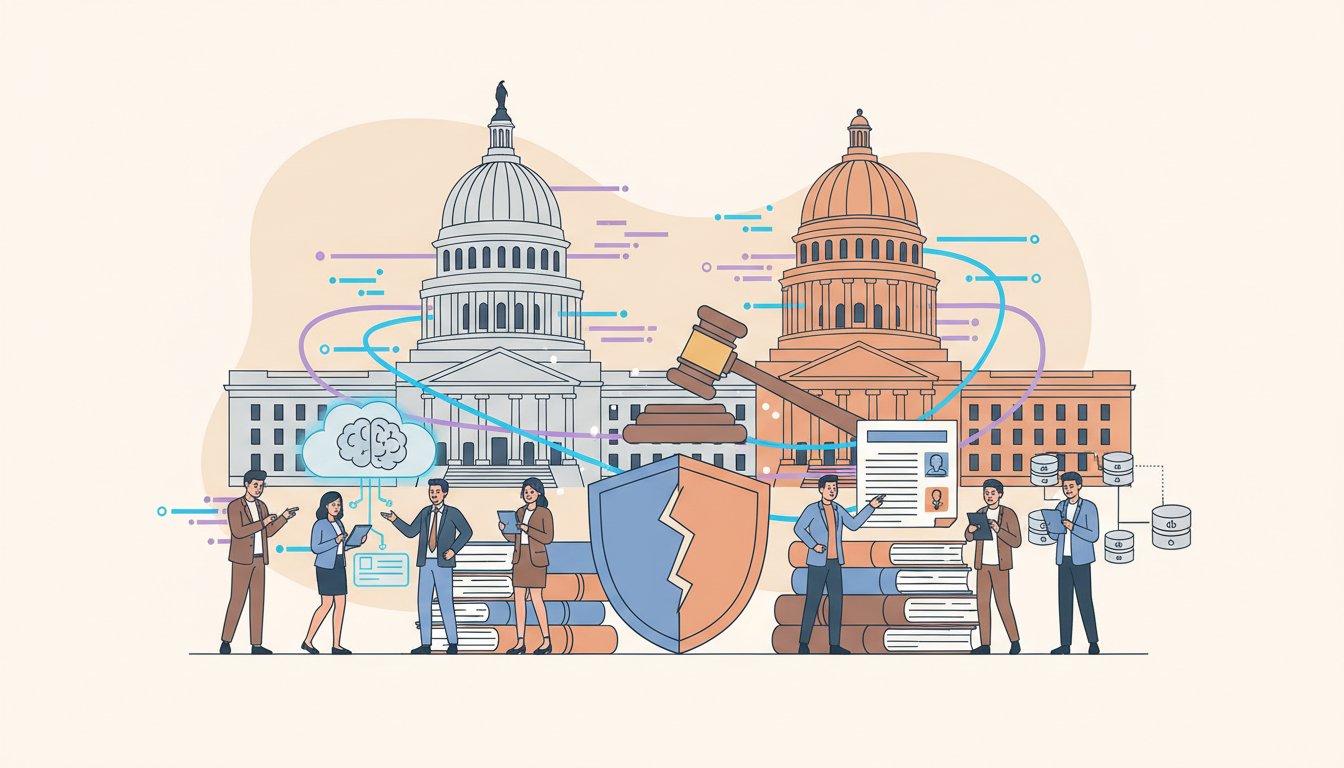
A recent development in the regulatory landscape for artificial intelligence has highlighted a growing conflict between federal policy and state-level legislative efforts. In February 2026, reports surfaced that the White House Office of Intergovernmental Affairs issued a formal communication expressing categorical opposition to Utah’s House Bill 286, also known as the Artificial Intelligence Transparency Act. This intervention signals a significant shift in how the federal executive branch may use preemption strategies to manage the patchwork of emerging state AI laws.
The Conflict Between Federal Directives and Utah H.B. 286
The White House pressure on Utah lawmakers follows a December 2025 executive order that instructed the Department of Justice to establish an AI litigation task force. This task force is designed to identify and challenge state-level AI regulations that the administration deems incompatible with its broader federal strategy. According to reports from Axios and the Financial Times, White House officials have directly urged the sponsor of H.B. 286, Representative Doug Fiefia, to halt the bill’s progress despite it having already advanced through committee.
The Utah measure aims to impose specific requirements on frontier AI developers, including:
- Mandatory publication of public safety and child-protection plans.
- Enhanced whistleblower protections for employees of AI development firms.
- Enforcement by the state Attorney General, including civil penalties for non-compliance.
- An effective date as early as May 2026, as indicated in sponsor summaries.
Legal Risks and Compliance Fragmentation
For legal personnel and corporate counsel, the friction between Utah’s legislative goals and federal opposition creates immediate uncertainty. The potential for a Department of Justice challenge increases the risk of preemption litigation, which can complicate long-term compliance strategies. Organizations operating across multiple jurisdictions must now account for a regulatory environment where state mandates may be nullified by federal courts, yet remains enforceable by state authorities in the interim.
Navigating these complexities requires robust secure private legal AI solutions that allow firms to track legislative changes in real-time. As more states like California, Colorado, and Utah introduce disparate safety and transparency requirements, the burden on in-house legal teams to update risk assessments and incident reporting channels grows. This environment makes the use of a vector database for legal search essential for managing the high volume of statutory and regulatory documentation produced across different jurisdictions.
Data Management and Legal Technology Implications
The increased likelihood of internal investigations—driven by H.B. 286’s whistleblower protections and mandatory safety reporting—places a premium on how law firms handle discoverable materials. Managing these documents requires advanced technical strategies, such as a legal vector search implementation, to ensure that privilege is maintained while complying with transparency mandates. To optimize these processes, many firms are exploring RAG vs. fine-tuning for law firms to determine which approach best serves their specific litigation and discovery needs.
Furthermore, the adoption of private RAG architecture reference patterns can help firms protect sensitive client data while leveraging the power of large language models. By using retrieval augmented generation for legal documents, attorneys can more efficiently cross-reference state-specific requirements with federal executive orders, reducing the manual labor associated with multi-state compliance audits. Implementing these technologies correctly is vital for reducing hallucinations in legal AI and ensuring that the counsel provided to clients is based on the most current and accurate legislative data.
Conclusion
The federal intervention in Utah’s legislative process serves as a case study for the upcoming legal battles over AI governance. As the Justice Department task force begins its work, law firms and insurance companies must prepare for a period of heightened litigation risk and shifting compliance benchmarks. Coordinating state-level defense strategies with federal litigation planning will be a critical task for counsel in the coming months, necessitating the use of sophisticated data management tools to stay ahead of regulatory changes.
Sources
- Scoop: White House pressures Utah lawmaker to kill AI transparency bill, Axios.
- Trump leans on Utah Republicans to scrap AI safety bill, Financial Times.
- HB0286 — Artificial Intelligence Transparency Amendments, Utah Legislature.
- TCAI Bill Guide: Utah’s HB 286, Transparency Coalition.